

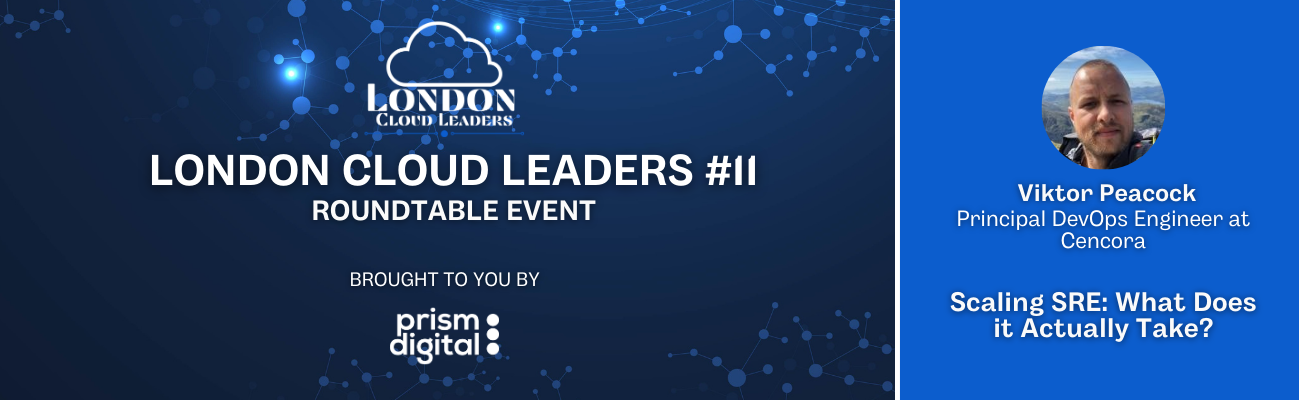
Presented by Prism Digital
This roundtable explores what it takes to scale SRE in the age of AI, when systems push 1,000 plus TPS, run multi-cloud, and operate at 99.95 percent and above SLAs. We’ll discuss how an SRE guild evolves from a few specialists to hundreds of engineers, what “scaling” actually means, and which tooling, automation, and AI-driven workflows prevent teams from solving scale by just hiring more people.
Questions we’ll explore:
- What does “scaling SRE” actually mean in your organisation?
- What are the core ingredients of an SRE function that can grow from a handful of experts to 300 plus engineers?
- Where should AI be applied in alerting, SLOs, incident response, root cause, and chaos engineering?
- What tooling is essential to avoid linear growth of people with traffic?
- How do you build a culture where every engineer owns reliability?
- How do you justify the investment to senior leadership?
- What metrics prove success when operating at high throughput and tight SLAs?
This discussion will be facilitated by Viktor Peacock, who is a technologist with a decade of experience across cloud, reliability, distributed systems, and scaling teams. His background spans telecoms, gambling, ecommerce, and high-scale finance, starting with .NET backend systems before moving into AWS, GCP, Azure, and Go.
At Domino’s, he helped drive the move from a monolith to microservices and solved major traffic-spike challenges. At Form3, he helped build the first active-active-active multi-tenant payments platform serving more than 70 percent of UK Faster Payments under tight P99.95 SLAs and later scaled an SRE capability from scratch to 300 engineers across multiple clouds.
He now works at Cencora, splitting his time between hands-on engineering and shaping long-term reliability strategy.
Event Details
Date: Thursday, 29th January
Location: London Bridge
Time: 5:30pm to 8:30pm
Food and drinks provided (free)
Chatham House rules apply
Agenda
5:30pm to 6:00pm – Arrival and networking
6:00pm to 6:15pm – Introductions
6:15pm to 7:00pm – Session part one
7:00pm to 7:10pm – Break
7:10pm to 7:45pm – Session part two and discussion
7:45pm to 8:30pm – Networking and wrap-up


